
Ready to get started?
Contact UsA 120-volt outlet adds a few miles an hour. A Level 2 charger on its own 240-volt circuit fills most cars while you sleep. We check your panel first, pull the permit, and give you one written price before we start.
If you are charging from a regular wall outlet, you already know the feeling. You plug in at dinner and the car is still not full at breakfast. That is Level 1 charging. It works for a plug-in hybrid with a small battery. It does not work for a full EV you drive every day, and it turns every long trip into a math problem.
A Level 2 charger runs on a dedicated 240-volt circuit, the same kind that feeds a dryer or a range. It adds roughly 25 to 45 miles of range per hour depending on the car and the charger. Most drivers plug in when they get home and wake up to a full battery, every day, without thinking about it again.
Nearly all EV charging happens at home. That is why the circuit in your garage matters more than any public charger on the highway, and why it needs to be done once, done to code, and sized for the car you drive now and the one you may buy next.
Level 2 home chargers. A dedicated 240-volt circuit from your panel to your garage or driveway, with the charger mounted where the cable reaches the port without stretching. Works with every EV sold in the US, including Ford, Chevy, Hyundai, Kia, Rivian, BMW and Tesla. Typical use: the daily driver that parks in the same spot every night. Detail: most chargers run at 40 or 48 amps. We size the breaker and wire to the charger's rating and to what your panel can carry, and we tell you which one you are getting and why.
Tesla Wall Connector. Mounting, wiring, Wi-Fi setup and app pairing for the Gen 3 and Universal Wall Connector. Typical use: one or more Teslas at home, or a household that wants the Universal unit so a second, non-Tesla car can use the same charger. Detail: the Wall Connector can run up to 48 amps on a 60-amp circuit, and it can share one circuit between several connectors. Full write-up on our Tesla Wall Connector installation page.
Charger with a panel upgrade. Many homes in Canton, Woodstock and Cartersville were built with 100- or 150-amp panels. Some are already full. Typical use: a house with an electric range, an electric dryer, a heat pump and no open breaker spaces. Detail: we tell you up front whether your panel can carry a new 40- to 60-amp circuit, and when it cannot, we upgrade the panel and install the charger in one visit, one crew, one invoice. The panel work itself is described on our residential electrical panel upgrades page.
Garage, carport and outdoor installs. Weatherproof enclosures, conduit run the right way, and GFCI protection where the code calls for it. Typical use: a car that parks in the driveway, under a carport, or beside a detached garage or barn. Detail: outdoor units are rated for rain and dust, but the wire route, the box, and the mounting height decide whether the install passes inspection and survives ten North Georgia summers.
Smart chargers and load management. ChargePoint, Emporia, Wallbox and similar units that schedule charging for off-peak hours and share power between two cars on one circuit. Typical use: a household on a time-of-use rate, or a panel that cannot spare a full 60 amps. Detail: load management lets a charger throttle itself so the panel never sees more than it can handle, which can turn a "you need a panel upgrade" into "you don't."
Two cars, townhomes and HOA properties. Load-sharing setups that keep two vehicles charged overnight without overloading the panel, and the paperwork HOAs ask for. Typical use: two EVs in one garage, or a townhome where the panel is shared or the parking is assigned. Detail: two chargers on one 60-amp circuit with power sharing will fill both cars overnight for most drivers. We also prepare the electrical drawing and permit copy an HOA board usually wants before it approves.
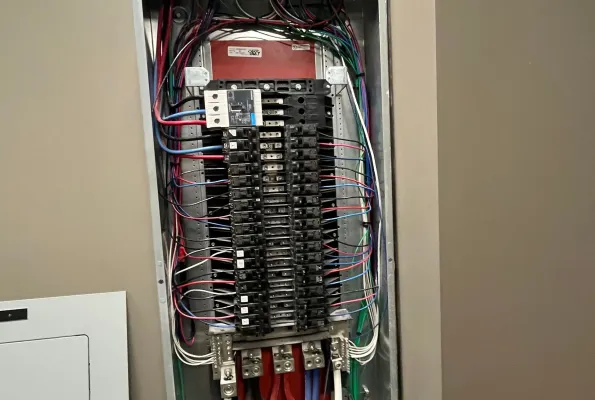
A charger is only as good as the circuit behind it. Adding a 50-amp load to a panel that is already near its limit trips breakers, heats wiring and fails inspection. Every one of our EV jobs starts with a look at your panel: the main breaker size, what is already on it, the age and brand of the panel, and the space left for a new breaker. We run the load calculation the code requires instead of guessing from the label. Then we quote the whole job, charger and any panel work, on one written flat-rate price. No surprises after the truck leaves.
If your panel can carry the charger, we say so and we do not sell you a panel. If it cannot, you hear that before any work starts, with the reason, and the choice of a load-managed charger or an upgrade.
Permit and code. Georgia requires a permit for a new 240-volt circuit, and inspectors check it. We pull the permit, wire to the current National Electrical Code, schedule the inspection, and hand you the signed-off paperwork.
Free panel capacity check. We look before we quote. That is the step most quotes skip, and it is the reason a lot of EV installs end in a tripped main breaker six months later.
Flat-rate written quote. The number on the paper is the number on the invoice. No hourly meter running, no "we found something" add-ons after the fact.
Warranty preserved. Tesla, ChargePoint, Wallbox and most other makers require a licensed install for the product warranty to hold. A permitted, licensed job keeps that warranty in force.
Resale and insurance. An unpermitted 240-volt circuit can stall a home sale when the buyer's inspector finds it, and it can give an insurer a reason to deny a claim. A permitted install shows up as an asset, not a problem.
Fixed right if it ever needs it. We service what we install, and we fix chargers other people installed. If a breaker trips, a unit drops off Wi-Fi, or an outdoor box takes water, you call the same number.
The Wall Connector is the fastest home option for a Tesla, but only when the circuit behind it is right. A Gen 3 or Universal Wall Connector on a 60-amp circuit delivers its full rate. On a 40-amp circuit it is throttled to match. We mount the unit where the cable reaches the port, wire it on the correct breaker, connect it to your Wi-Fi so the Tesla app can see it and update it, and set power sharing when the household has more than one car. If you have a Powerwall or plan one, the two are set up to work together so the car does not drain your backup during an outage. Everything about circuit size, Gen 3 versus Universal, access control for outdoor units, and Powerwall pairing is on the Tesla Wall Connector installation page.
Not every call is a new install. If your charger is slow, drops out, or stopped working, these are the usual reasons:
We diagnose it, tell you what we found, and quote the repair flat-rate before we touch it.
Utility programs and incentives change often and differ between Georgia Power and the EMCs that serve Bartow, Cherokee, Cobb and Forsyth counties. Some utilities offer a rebate on the charger or a lower overnight rate for EV owners. Some offer nothing. Ask us what applies to your address when we do the evaluation, and confirm any tax treatment with a tax professional. We give you the itemized invoice, permit copy and install details most programs ask for, so you are not chasing paperwork after the job.
Tesla · ChargePoint · JuiceBox · Emporia · Wallbox · Grizzl-E · Leviton · ClipperCreek. If you already bought a charger, we install that one. If you have not, we match the charger to your car and your panel.
White, Cartersville, Adairsville and Emerson in Bartow County. Canton, Woodstock, Holly Springs and Ball Ground in Cherokee County. Marietta, Kennesaw, Acworth and Powder Springs in Cobb County. Cumming, Dallas, Hiram, Jasper and Calhoun. Call for anywhere else in North Georgia.
Call (678) 880-4570 or book a free on-site evaluation. Flat-rate written quote before any work starts. Do it right. Do it safely. Do it with integrity.