
Ready to get started?
Contact UsTwo houses can get very different prices for the same charger, and both can be fair. Here is what decides the number, what makes it go up, and how to get a real quote instead of a guess.
Four things decide the cost of a home EV charger install: how far the charger is from your electrical panel, whether the panel has room and capacity, whether the run is inside a finished garage or outside, and the permit. The charger itself is the smallest part of most jobs. Labor and wire are usually the larger share. A free on-site evaluation gives you a flat-rate written price that covers all of it.
Below, each driver, with the scenario that puts it at the low end and the one that puts it at the high end, so you can see where your house falls before anyone comes out.
Level 1. The cord that came with the car, plugged into a regular 120-volt outlet. It adds about 2 to 5 miles of range per hour, so a full charge on a modern EV can take days. There is no install cost beyond having a good outlet near the car, and for a plug-in hybrid with a small battery that is sometimes enough. For a full EV driven every day, it is not.
Level 2. A charger on its own 240-volt circuit, the same kind that feeds a dryer or a range. Depending on the charger's amperage and the car, it adds roughly 25 to 45 miles of range per hour, which fills a daily commute overnight. This is what nearly every home install is, and the rest of this page is about it. The hardware is one of the smaller lines. The circuit is the job.
DC fast charging. The highway chargers and Superchargers, running at hundreds of volts and drawing more power than most homes' entire service. They are not a residential product. The electrical service, the equipment cost and the utility requirements put them out of reach for a house. If you see "Level 3 at home" advertised, walk away.
The charger needs its own 240-volt circuit run from the panel. A panel in the garage next to the parking spot is the easy case: a few feet of wire, an hour or two of work. A panel in the basement on the far side of the house, with the car in a detached garage, means a long run through finished space or underground, more wire, possibly trenching, and most of a day. Wire is priced by the foot and by the size, and a long run may need heavier wire to keep the voltage up, so distance moves the price twice.
Low end: panel on the garage wall, charger ten feet away. High end: panel in the basement, charger in a detached garage a hundred feet across the yard.
A Level 2 charger usually needs a 40- to 60-amp breaker. A 200-amp panel with open slots takes it easily. A 100-amp panel that already feeds an electric range, dryer and two HVAC units may not have the capacity under the load calculation the code requires, and a full panel may not have the space for the new breaker. Older brands the inspector will not accept new work on (Federal Pacific, Zinsco) need replacing regardless.
The fixes, from least to most involved: a smaller circuit with the charger set to match, which slows charging a little. A load-management device that shares capacity with the house so the charger backs off when the dryer runs. Or a panel upgrade, which is the largest line on any EV quote when it is needed, and which also lowers the cost of every future upgrade. We tell you which applies before we quote, and we recommend the upgrade only when the numbers require it. Our panel upgrades page covers the work itself.
Low end: 200-amp panel with two open spaces. High end: 100-amp panel, full, on a house with electric everything.
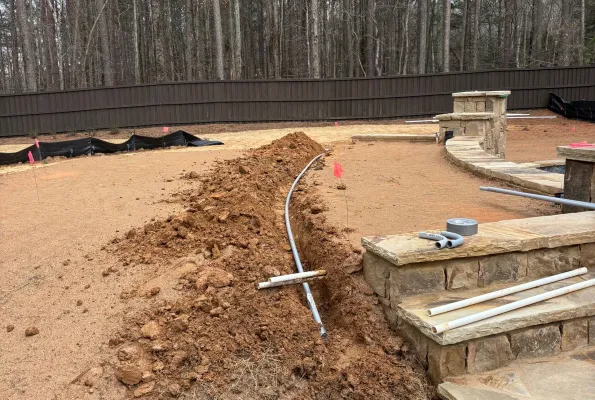
An indoor install in a finished garage is straightforward. An outdoor install adds weatherproof conduit, a rated enclosure, a drip loop, a mounting height off the ground, and GFCI protection where the code calls for it. A pedestal in a driveway or beside a carport adds trenching, conduit underground and a post. None of it is exotic, but each piece is labor and parts that a garage install does not have.
Low end: garage wall, indoor unit. High end: driveway pedestal fed by a trench.
A new 240-volt circuit needs an electrical permit and an inspection in Georgia, and the county fee varies. It is a modest line on the quote next to the labor and wire, and it is what keeps the charger's warranty valid, your insurance clean, and a home sale from stalling when the buyer's inspector looks in the panel. A quote that leaves the permit off is not a lower price. It is incomplete.
On a typical Level 2 install the charger itself is one line and the circuit, the breaker, the wire, the conduit, the mounting and the permit are the rest. Labor is usually the largest single share. That is why a quote from a company that only sells chargers can look low: it is the small part of the job. Ask for the whole number.
The brand of charger, within the mainstream units. A plug-in versus hardwired charger. Wi-Fi and app features. The color.
Not much. Online EV-charger calculators assume an average distance to an average panel with average capacity, and they know nothing about whether your panel is full, whether the run crosses a finished ceiling, or whether the county wants the charger on a GFCI breaker. They tend to miss the panel upgrade entirely, which is the one line that can double a job. Use them to learn the vocabulary. Use a licensed electrician's on-site evaluation to get the number.
Utility rebates for home chargers come and go and differ between Georgia Power and the EMCs that serve Bartow, Cherokee, Cobb and Forsyth counties. Some also offer a lower overnight rate for EV owners. Ask us what applies to your address, and confirm any tax treatment with a tax professional. We supply the itemized invoice and permit documents programs ask for.
Most EV charger installs are paid outright. When a panel upgrade turns the job into a larger project, ask us about payment options when we quote. We will tell you plainly what is available.
A flat-rate written quote from a licensed electrical contractor answers all six.
Flat-rate written quote before any work starts.