
Ready to get started?
Contact UsA commercial solar array is an electrical project first. Service capacity, interconnection, disconnects, code, inspection. Since 2003 we have built and repaired electrical systems for warehouses, shops, farms and facilities across North Georgia, and we build solar the same way: engineered to your service, permitted, and quoted on one written price.
Electricity is one of the few operating costs you cannot negotiate. Rates move in one direction, and a facility that runs compressors, ovens, refrigeration or a production line feels every increase. A solar array on your roof or your land turns part of that cost into a fixed asset with a known price for the next 25 years: the power it makes costs the same in year twenty as it did in year one. Add storage and you cut demand charges and keep critical loads running through an outage, which for a cold-storage warehouse or a clinic is the difference between a bad afternoon and a lost inventory. And you own it, on your books, with whatever depreciation and incentives apply to your project, if any.
Rooftop solar. Ballasted or attached arrays on flat and low-slope commercial roofs, sized to the structure and the service. A ballasted system needs no roof penetrations. An attached system is the answer on metal and pitched roofs. We check the roof's remaining life and the structure's load rating before we design.
Ground-mount solar. For facilities with land: farms, distribution yards, campuses, and any site where the roof is not the answer. Ground mounts face exactly the right way, are easy to service, and can be built as shade structures.
Solar carports. Covered parking that generates power, on lots where roof space is short. Employees and customers get shade. The array gets a clear, unshaded sky. And EV charging can hang from the same steel.
Solar plus battery storage. Peak shaving, demand-charge reduction and backup for critical circuits, sized from your interval data.
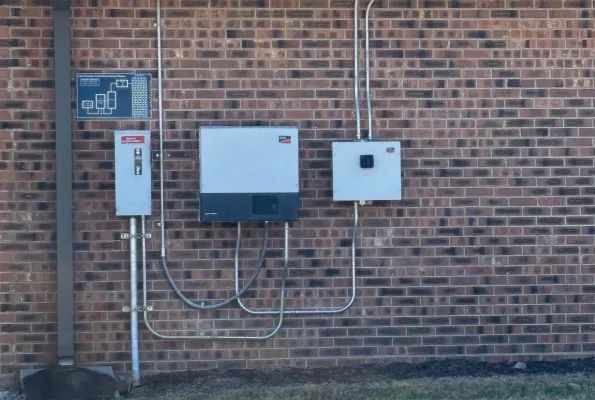
Service and interconnection work. Service upgrades, switchgear, disconnects, metering and the utility interconnection, done by the same crew that builds the array. On 400- and 600-amp services and above, this is most of the job.
EV charging paired with solar. Workplace and fleet charging fed by the array. See our commercial EV charging page.
Warehouses and distribution. Large flat roofs, steady daytime loads from lighting, dock equipment and climate control. The roof is the resource. A ballasted array covers it without penetrations, and the building's daytime load soaks up the production.
Manufacturing and light industrial. Motors, compressors, welders and ovens create high demand peaks. The array offsets the daytime base load and storage shaves the peaks that set the demand charge. Our industrial electrical background (three-phase services, motor controls, VFDs) is what makes the tie-in clean.
Farms and poultry. Power at the back of the property, ventilation fans that cannot stop, well and irrigation pumps, and grant programs that only rural businesses can use. Ground-mount is the usual answer. Our farm solar page covers this in depth.
Churches and schools. Big roofs, predictable schedules, and a fixed budget where a lower power bill means more for the mission. Nonprofits have purchasing options that a for-profit business does not, described below.
Self-storage. Expansive roofs, low interior load, and a business model built on keeping overhead down. An array on a storage facility often covers all of the site's usage, and the surplus feeds the utility's buyback program if it has one.
Retail, restaurants and hospitality. All-electric kitchens, refrigeration, long hours. A hotel or a restaurant runs a large load through the daylight hours, which is exactly when the array produces. Carports on the customer lot are a common fit.
Offices and medical. Daytime-heavy loads that match solar production almost hour for hour. Medical practices add storage so imaging, refrigeration for vaccines and samples, and network equipment ride through an outage.
Municipal and nonprofit buildings. City halls, community centers, fire stations and water facilities with long service lives and public budgets. Fixed energy cost for decades, and storage for the buildings that have to stay open during a storm.
Multifamily. Common-area loads (lighting, elevators, pools, laundry) on the owner's meter, where a fixed cost improves net operating income and the property's appeal.
Dealerships. Showroom lighting, service bays and the EV inventory that now needs charging on the lot. The array feeds both the building and the chargers.
Each has a different load profile, roof, and reason for going solar. A warehouse wants the roof covered. A church wants to cut a fixed cost. A farm wants power at the back of the property. We design to the reason.
Most commercial solar companies subcontract the electrical work. We are the electrical contractor. That means the person sizing your array is the same person who knows whether your 400-amp service can take it, where the disconnect goes, what the inspector will look for, and how to keep production running while the tie-in happens. Our crews do high-voltage work, motor controls, PLC integration and arc-flash studies for industrial customers, so a commercial solar tie-in is not a stretch for us. It is the kind of electrical work we already do. It also means we are the people other installers call when a job does not pass.
For many facilities the bill is not about kilowatt-hours. It is about the demand charge, the fee for the highest fifteen minutes of draw in the month. A battery shaves that peak by discharging when the plant starts up or the compressors kick on together, so the meter never sees the spike. It also keeps the critical circuits on, refrigeration, servers, controls, security, when the grid drops, and it lets a facility ride out the afternoon peak on stored solar instead of buying the most expensive power of the day. We size storage from your interval data, not from a rule of thumb, and we design the switchgear so the battery, the array, the grid and any generator work together.
Agricultural operations have different needs and, at times, different funding paths. Long runs to remote loads, well and irrigation pumps, poultry ventilation, multiple meters on one property, and grant programs that only rural businesses can use. Our farm solar page covers that side in full.
A meaningful share of our commercial solar work is repair: arrays that never produced what was promised, tie-ins that failed inspection, inverters that faulted and were never serviced, monitoring that stopped reporting the day the installer's company closed. If you inherited a system with a building, or the company that installed yours is gone, we can assess it, repair it, and bring it to code. See solar repair.
A commercial array is a piece of equipment, and equipment that nobody watches drifts. Our maintenance plans include monitoring alerts handled by us rather than left in an inbox, a scheduled visual inspection of the array, racking, wiring and conduit, string and inverter testing to catch a bad connection or a failing string before it costs a month of production, an annual written report on system health, and monthly or quarterly production reports against the design estimate. Inverter warranty claims and manufacturer contact are handled on your behalf. Plans are scoped to the system. A 50 kW rooftop and a 1 MW ground mount do not need the same visit schedule.
Cash purchase. Full ownership from day one, the shortest payback, and any incentive or depreciation benefit that applies to your project, if any, flows to you.
Loan. The system is yours, any incentives that apply are yours, and the monthly savings on the power bill go toward the payment. Financing the net cost after incentives gives the shortest payback.
Power-purchase agreement, for nonprofits. A third party owns the system on your roof and you buy the power it makes at an agreed rate. You do not own the array and you do not take the tax benefits, but there is little or no upfront cost, and many agreements let you buy the system later. Common for churches, schools and community organizations.
Federal incentives, depreciation and rural grant programs may apply depending on the project and its timing. The rules have changed recently and keep changing. Ask us what applies to your project, and have your accountant in the conversation before you decide. We provide the itemized invoice and project documentation a tax professional needs.
Every commercial system is different: size in kilowatts, roof or ground, storage, and how much electrical work the service needs before it can take the array. What we can promise is one written flat-rate price that includes the electrical work, so the number you approve is the number you pay.
We build rooftop, ground-mount and carport systems, battery-backed systems, and tie-ins on 200-, 400- and 600-amp services and above, for facilities across North Georgia. Ask to see recent projects in your vertical when we come out for the evaluation.
Class II licensed, EN213261, and the service, switchgear and interconnection are ours, not a subcontractor's.
Twenty-three years of commercial and industrial electrical work in North Georgia.
High-voltage, three-phase, motor controls, VFDs, PLC integration and arc-flash studies, on the same crew that builds your array.
Flat-rate, with every part of the job on it.
A large share of our solar work is bringing other installers' systems to code.
Owned by Jarod Simmons, based in White, Bartow County, a member of the Cherokee County Chamber of Commerce, and here when you call in year ten.
Every job permitted and inspected. Insurance documents available on request.
Call (678) 880-4570 or book a free on-site evaluation. Flat-rate written quote before any work starts. Do it right. Do it safely. Do it with integrity.