
Ready to get started?
Contact UsFarms use power in the wrong places for the grid: the well at the back of the property, the poultry house, the shop, the irrigation pump. A ground-mount array puts the power where the load is. We do the trenching, the long runs, the disconnects and the tie-in.
Agricultural loads are big and far from the meter. Ventilation fans and heaters in a poultry house run all day. Irrigation and well pumps start hard and run for hours. Shops run compressors and welders. Grain dryers, coolers and processing equipment come on in bursts. The bill arrives every month whether the year was good or not, and the utility's rate for a rural service is often higher per kilowatt-hour than a town would pay. Solar turns that bill into a one-time cost on land you already own, and it puts generation next to the load instead of at the end of a long, lossy run from the road.
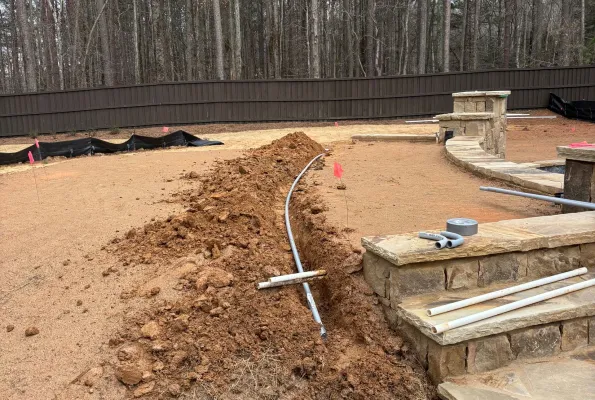
Most farm solar is ground-mounted: rows of panels on a steel rack in a field or beside a building, with trenched conduit running to the loads or the service. A ground mount can face due south at the ideal tilt with nothing shading it, it is easy to walk up to and service, and it does not depend on the condition of a barn roof. Some farms put panels on a barn, shop or equipment-shed roof when the roof is sound and faces the right way. Some build a shade structure that covers equipment, feed or livestock and makes power at the same time. Battery storage keeps critical loads, like a poultry house fan bank or a walk-in cooler, running through an outage. Larger operations run 20 kW and up, on 200-, 400- or 600-amp services, and often tie into more than one meter.
Ground mount. The default on a farm with open land. Fixed-tilt racks on driven posts or concrete piers, panels set at the angle that suits North Georgia's latitude, rows spaced so they do not shade each other in winter. Fencing keeps livestock off the wiring. Easy to expand later by adding a row. The cost is the rack and the trench. The return is production that nothing on the property can shade.
Barn or shop roof. Lowest-cost structure, because the building already exists, and standing-seam metal takes clamp-on racking with no holes. The limits are the roof's direction, its condition, and what is under it: an old wood-truss barn may not carry the load, and a roof that will be replaced in five years should be replaced first.
Shade structure. A steel canopy over an equipment yard, a feed area, a loafing shed or a parking row, with panels as the roof. It gives shade the operation wanted anyway, keeps the panels high and out of harm's way, and can be sited close to the load it feeds. More steel than a ground mount, so it costs more per panel, but it does two jobs.
Tracker systems. Racks that follow the sun make more power per panel but add moving parts to maintain in a field. On most farms a larger fixed array beats a smaller tracking one on cost and upkeep. We run the comparison when the land is tight.
On the evaluation we price the two options that fit your property, so you see the real difference instead of guessing.
Farm solar is mostly wire. Long underground runs, voltage-drop calculations, disconnects at each building, grounding and bonding across outbuildings, tying into a service that may be split across the property. This is electrical contracting, and it is what we have done in Bartow, Gordon, Pickens, Paulding and Cherokee counties since 2003. Mistakes on a farm run are expensive to find and expensive to fix: an undersized run to a well 800 feet out starves the pump. A missing disconnect fails inspection. A poorly bonded outbuilding is a shock hazard around livestock and water. We size the runs right the first time, and the same licensed crew does the trenching, the conduit, the tie-in and the inspection paperwork.
Poultry ventilation is a life-safety load. Tunnel fans, cooling pads, heaters and feed lines run around the clock in summer and winter, and an outage of a few hours in July can lose a flock. Most growers already have a generator for that reason. A solar array with battery storage adds a second layer that takes over in a fraction of a second, without the transfer delay, and it pays down the largest electric bill on the farm the rest of the year. A four-house operation on a hot afternoon draws power almost exactly when a ground mount is producing the most.
We size the battery to the fan load first, so that every house's ventilation stays on through the switchover, then the array to the bill. The generator stays as the long-outage backstop and can recharge the battery. We also look at the controller and alarm wiring while we are there. The ventilation controller has to see the backup source as normal power or it will alarm and shut down.
Pump motors pull several times their running current when they start. A 10-horsepower well pump can draw the equivalent of a whole house for the first second. A solar and battery system that is not designed for that surge trips on the first start, and a long run that was sized for running current sags on startup and cooks the motor over time. We design for the motor: inverter and battery rated for the locked-rotor draw, wire sized for the surge and the distance, and soft-starts or variable-frequency drives where they help, which also lowers the running cost. Center-pivot irrigation, livestock watering, and a well half a mile from the house each get the same math.
The farm shop is often the second-biggest load on the property: welders, an air compressor, lifts, lighting, sometimes a grain dryer or a cooler on the same panel. A shop has a roof that may carry panels, and it usually has a subpanel that can take the tie-in. We look at whether the shop should be its own solar system, a load on the main array, or the place the battery lives. Equipment sheds and barns with metal roofs are good candidates for clamp-on arrays with no roof penetrations.
Many farms have more than one meter and more than one service: the house, the poultry houses, the well, the shop, each billed separately, sometimes by different rate schedules, sometimes even different utilities where a county line runs through the property. Where the array ties in decides which bill it offsets and whether the utility treats it as one system or several. We map every meter and service on the evaluation and design the tie-in so the array offsets the biggest bill first, or so the whole property runs through one point where that is allowed. Disconnects at every building, the labeling the inspector expects, and the interconnection paperwork with Georgia Power, Amicalola EMC, Cobb EMC or Sawnee EMC are all on the quote. If a service needs to grow before it can carry the array, that is on the quote too.
Agricultural producers and rural small businesses have had access to grant and loan programs that other property owners do not, including federal rural-energy grant programs that can cover a share of a solar project, and federal incentives and depreciation may apply to the project as a business asset. These programs have application windows, eligibility rules and paperwork requirements that change from year to year. We do not promise any of them. Ask us what is open when you are planning, and we will help you gather what the application needs: the energy audit or usage history, the system design and production estimate, the itemized quote, and the contractor documents. Talk to your accountant or your extension office before you count on a grant in the budget.
Rural feeders are the last to come back after an ice storm. A farm with a battery and an array rides the first day on its own. With a generator behind it, it rides the week. We design the outage plan around the loads that cannot stop: ventilation, water, refrigeration, and the house.
Before we design anything we walk the property: where the loads are, where the meters are, where the ground is open and unshaded, where the trench can run without cutting a field road or a water line, and how far the array is from what it feeds. Long runs are fine when they are sized. We calculate the voltage drop and choose wire and voltage to keep it inside the limit, and we run higher voltage over the long leg when that saves copper.
Call (678) 880-4570 or book a free on-site evaluation. Flat-rate written quote before any work starts.