
Ready to get started?
Contact UsWhen a storm takes the lines down in Bartow or Cherokee County, a battery takes over in a fraction of a second. No cord to run, no gas to buy, no noise. We size it to what you need to keep running and install it to code.
Ice storms, summer thunderstorms, a tree on the line on Highway 20. When the power goes out, the fridge warms, the well pump stops, the CPAP quits, the sump pump sits, and if you work from home, so do you. A generator solves it with noise, fuel runs and a monthly test. A battery solves it silently and instantly, and it can pay for part of itself every day by running the house on stored power when rates are high or when your solar array is making more than you are using.
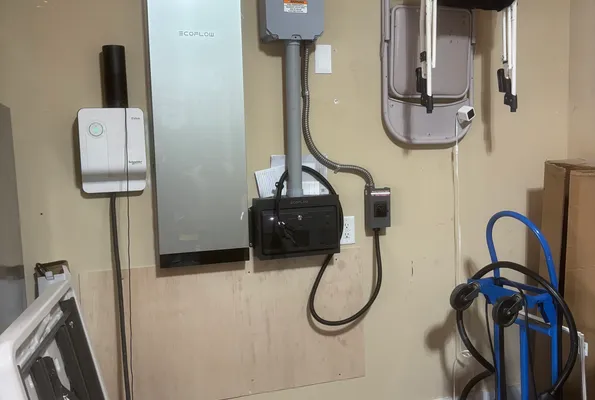
Whole-home backup keeps everything running: HVAC, well pump, kitchen, the lot. It takes a bigger battery bank, and often a larger inverter or two, but nothing in the house changes when the grid drops. On a 200-amp service that usually means two or more battery units and equipment rated to start the air conditioner.
Partial backup keeps the essentials on a dedicated backup panel: refrigerator, freezer, well pump, some lights and outlets, a furnace blower or a mini-split. It is the smaller, lower-cost option and it is what most homes choose, because it covers what matters for days on one or two units instead of hours on a whole-home load.
Reduced whole-home is the middle path: everything stays connected, but the biggest loads (central air, the electric range, the dryer, the water heater) are put on a smart panel or load controller that sheds them during an outage. You keep the convenience of one panel and the runtime of a partial system.
We map your loads on the evaluation and show you all three in writing.
You do not need solar to have a battery. A battery-only system charges from the grid, sits full, and holds power for the next outage. It can also charge overnight and run the house during the afternoon peak if your utility's rate plan rewards that. Add solar and the battery recharges during a multi-day outage, and on a normal day you run the house on your own power at night instead of selling the afternoon surplus back for less than you paid. Our home solar page covers the array side. The two are designed together when both are on the table.
Tesla Powerwall 3. Battery and inverter in one unit: 13.5 kilowatt-hours of usable storage and 11.5 kilowatts of continuous output per unit, with enough starting power to kick a well pump or an AC compressor. Expansion units stack under the first for more capacity, the solar inverter is built in, and the Tesla app handles monitoring and outage mode. Pairs with the Wall Connector so an EV does not drain the backup.
EcoFlow OCEAN Pro, Delta Pro Ultra and Smart Home Panel. Modular systems that scale from a partial backup panel to whole-home 200-amp coverage across two Smart Home Panels, with circuit-by-circuit control in the app: you choose which rooms and appliances get power, and you can change it from your phone during an outage. Capacity expands by adding battery modules. Switchover from grid to battery happens in milliseconds.
Sol-Ark hybrid inverters. The choice for larger and custom systems, especially with ground-mount solar, a generator input, or 400-amp services. A Sol-Ark inverter manages grid, solar, battery and generator in one box, works with several battery brands, and can be built into big banks for a shop or a large home.
We match the equipment to the job. The right system for a 1,400-square-foot house on a 100-amp panel is not the right system for a 6,000-square-foot house with a shop. Brand names here are products we install. Ask us which fits your house.
It comes from two numbers: how much power you need at once, which decides the inverter, and how long you need it, which decides the battery capacity. A well pump and an HVAC compressor starting together is a big instant load. Running a refrigerator and lights for two days is a big total load.
Here is the math, using a Powerwall 3 as the unit (13.5 kWh usable each). Add up the daily kilowatt-hours of what you want to keep on. A typical essentials list (refrigerator, freezer, well pump, furnace blower, internet, lights, a few outlets) runs 8 to 12 kWh a day. A Canton house that wants 24 hours of essentials with no solar to recharge needs about 12 kWh of storage: one unit covers it, two give a cushion. A Kennesaw house that wants the whole home, at 40 to 60 kWh a day, needs three or four units for one day, or two units plus solar to recharge them. Take your number, divide by 13.5, round up, and add one if you want margin for a cloudy stretch. We do this with your actual circuits on the evaluation, from twelve months of bills, not a square-footage guess, and we show you what one more or one less unit changes.
Runtime depends on what you keep on:
Those bands assume no recharge. With solar, a sunny day puts most of a unit's capacity back, which is why the essentials-plus-solar setup rides out a multi-day ice storm on one or two units.
A few habits double your runtime. Turn the thermostat up in summer and down in winter. Let the smart panel or the app shed the big loads (range, dryer, water heater) for the duration. Run the dishwasher and laundry at midday when the array is producing, not at night. Keep the well pump and the refrigerator on and treat everything else as optional. If you have a generator too, use it for the afternoon while the battery covers the quiet hours. The two together stretch fuel and storage both.
Indoors, a garage or basement wall is ideal: stable temperature, easy to service, out of the weather. Outdoors, the units we install are rated for it, and we mount on a north or shaded wall with clearance from the meter, off the ground, and away from the mower and the dryer vent. A Sol-Ark or EcoFlow system with several modules needs floor space and a clear path for service. The evaluation settles the spot and the conduit route to the panel.
A standby generator handles long outages as long as the gas or propane holds, but it is loud, it needs an annual service and a monthly test cycle, it burns fuel every hour it runs, and it does nothing on a normal day. A battery is silent, needs no fuel, switches over in a fraction of a second instead of the ten or so a generator takes, and can work every day shifting your usage to lower-rate hours or storing your own solar. A battery is limited by its capacity. A generator by its fuel. Many homes end up with both: the battery for the first day and the everyday work, the generator as the long-outage backstop that recharges the battery when the sun is not out. We install both, and our generator page covers that side.
A battery ties into the main service, adds a transfer or backup panel, and changes how the house connects to the grid. This is where inexperienced installers get it wrong: a backup panel wired so the battery can backfeed the grid, a main breaker left in the wrong place, a system that never got its utility interconnection approval. It is what we do for a living. Every install is permitted, inspected, and interconnected properly with Georgia Power or your EMC, and we service what we install.
On a partial backup, the essentials usually mean the refrigerator and freezer, the well pump if you have one, the furnace blower or a mini-split, the modem and router, some lights, and the outlets in one or two rooms. What usually stays off: the electric range, the dryer, the electric water heater, and a big central air conditioner, because each of those alone can pull as much as the rest of the house together. A whole-home battery bank carries all of it, at a higher cost. The evaluation is where we walk through your house circuit by circuit and mark the list.
Outages here come in two flavors: the summer thunderstorm that takes a line down for a few hours, and the winter ice storm that keeps a rural EMC busy for days. A battery covers the first on its own. For the second, the question is whether you have solar to recharge it, a generator to back it up, or a big enough bank to ride it out. We design for the outage you actually get, not the one in the brochure.
Call (678) 880-4570 or book a free on-site evaluation. Flat-rate written quote before any work starts.