
Ready to get started?
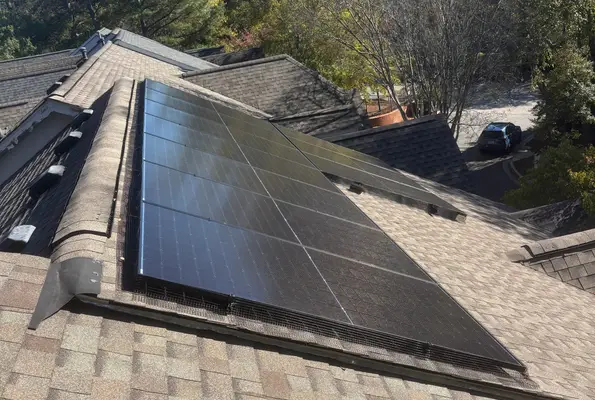
Contact UsYour solar system plugs into your home's electrical service. We are the people who build electrical services. Since 2003 we have wired, upgraded and repaired homes across Cherokee, Bartow and Cobb counties, and we install solar the same way: sized right, permitted, inspected, and quoted on one written price.
Most solar problems we fix started with a sales appointment. Someone sold a system, a crew installed it, and the electrical side was an afterthought: a panel that could not carry the backfeed, a service that needed upgrading, a disconnect in the wrong place, a job that never passed inspection. We know because we get called to fix them.
We start at the panel. What is your main breaker? How much of it is used? Will the array pass the 120 percent rule or does the service need to grow first? What else is coming, an EV charger, a heat pump, a battery? A solar system designed by an electrical contractor is designed around those answers, and it is built by the same licensed crew that does the rest of the electrical work in your house.
Locks in your electric cost. Once the system is paid for, the power it makes costs nothing more. Georgia Power and the EMCs adjust rates over time. The sun does not send a bill. Think of it as buying twenty-five years of daytime electricity at today's price instead of next decade's.
Keeps the lights on. Add a battery and the house runs through an outage. Without a battery, a standard grid-tied system shuts off when the grid does, by code, to protect line workers. If outages are your reason for solar, talk to us about battery backup at the same time, because the wiring for both is easiest to do once.
You own it. No lease, no power-purchase agreement, no lien on the house, no company that owns your roof. The system is yours from day one, it stays with the house, and it is an asset when you sell rather than a contract the buyer has to take over.
What it costs. The price of a home solar system depends on how big the system is, what kind of roof it goes on, whether your panel needs work first, and whether a battery is part of it. System size is the biggest driver, and the right size comes from your electric bills and your plans, not from a rule of thumb. We do not put a number on the phone or off a satellite photo. Our solar cost guide walks through each driver, and the free on-site evaluation produces the real number for your house, in writing.
How the process works. It starts with a free on-site evaluation by a licensed electrician: roof, panel, meter, service entrance, and a conversation about what you want the system to do. Then a design and a flat-rate written quote. Then we handle the county permit and the interconnection request with your utility. Then the install, usually one to three days on site. Then the county inspection, the utility's approval, and the turn-on. You have one company and one phone number the whole way, and the same crew that pulled the permit is the crew that flips the switch.
Why an electrical contractor. A solar array is about a third panels and two-thirds electrical work: the inverter, the disconnects, the backfeed breaker, the grounding, the conduit runs, the service capacity, the interconnection. That is what we have done since 2003. We size the electrical service before we size the array, we wire to the current code, and if your house also needs a panel upgrade, a generator interlock or an EV circuit, the same licensed crew does all of it on one written quote.
Orientation. A roof face that points south catches the most sun over a year. West and east faces do well too, with west producing later in the day when demand is high. A north-only roof usually means a ground mount or a smaller system than you hoped for.
Shade. Trees, a taller neighbor, a chimney or a dormer that shades the array for part of the day cut production more than most people expect, because one shaded panel can drag down a string. North Georgia has a lot of tall pines and oaks. Sometimes the fix is trimming, sometimes it is a different roof face, sometimes it is the yard.
Size. A home system needs open, unbroken roof area. Vents, skylights and hips break a roof into small pieces that hold fewer panels. We measure what is actually usable, not the whole roof.
Pitch. Steep and shallow roofs both work. The mounting hardware changes and so does the production estimate. Flat roofs use tilt racks.
Material. Architectural shingle is the most common and the easiest. Standing-seam metal is excellent, because the panels clamp to the seams with no roof penetrations at all. Tile, slate and old three-tab shingle each need their own approach.
Age. Panels are meant to stay up for twenty-five years or more. A roof that will need replacing in the next few years should be replaced first, so nobody has to remove and reinstall the array later. We will tell you that on the evaluation rather than after.
We look at all six on the free evaluation and tell you plainly if your roof is not a good candidate. Sometimes the answer is a ground mount. Sometimes the answer is no, and we would rather tell you that than sell you a system that disappoints.
This is the question a sales crew skips and an electrician cannot. The electrical code limits how much solar can feed back into a panel: the main breaker plus the solar breaker cannot exceed 120 percent of the panel's bus rating. On a 200-amp panel that leaves room for a solar breaker up to 40 amps, which covers most home systems. On a 100- or 125-amp panel, a normal-sized array will not fit under that rule without a panel upgrade or a different connection method, such as a line-side tap or a downsized main breaker.
A panel can also simply be full, with no open spaces for the solar breaker, or old enough that the utility or the inspector will not accept new equipment on it. Federal Pacific and Zinsco panels are the usual examples. We check the rating, the space and the brand before we design anything, and if an upgrade is needed, it is on the same written quote as the array. Read more on our panel upgrades page.
Battery backup. A battery stores what the array makes during the day and runs the house at night or through an outage. With Georgia Power or an EMC that pays little for exported power, a battery also lets you use your own production instead of selling it back for less than you pay. EcoFlow, Tesla Powerwall and Sol-Ark systems are all on our home battery backup page.
EV charger. An EV charged from your own roof is the lowest-cost mile you will drive. We run the 240-volt circuit and set up the charger to prefer solar production or off-peak hours. Details on our EV charger installation page.
Panel and service. Solar, a battery, an EV charger and a heat pump all land on the same panel. If the house was built with 100 or 150 amps, the panel is the bottleneck for every one of them. We plan the panel once for everything you are adding, instead of upgrading it twice.
We install rooftop and ground-mount systems, battery-backed systems, and larger systems on 400- and 600-amp services for homes and shops across Bartow, Cherokee, Cobb and Forsyth counties. Ask to see examples near you when we come out for the evaluation.
Power Through the Outage
What Moves the Price
Safe, Code-Compliant Power Expansion
Charge Overnight, Not Over a Day
We Fix What Others Left Behind
Power Where the Work Is
Call (678) 880-4570 or book a free on-site evaluation. Flat-rate written quote before any work starts. Do it right. Do it safely. Do it with integrity.